Hinge Prediction using Alpha Shape (API)
This tutorial familiarises users with the API of the Hinge Prediction algorithm using Alpha Shapes. The same functionality is also available in the PACKMAN commandline interface ( tutorials_hinge_prediction ).
How to cite:
Pranav M. Khade, Ambuj Kumar, Robert L. Jernigan, Characterizing and Predicting Protein Hinges for
Mechanistic Insight, Journal of Molecular Biology, Volume 432, Issue 2, 2020, Pages 508-522,
ISSN 0022-2836, https://doi.org/10.1016/j.jmb.2019.11.018.
Note: If PACKMAN is not installed, please follow the link: https://github.com/Pranavkhade/PACKMAN
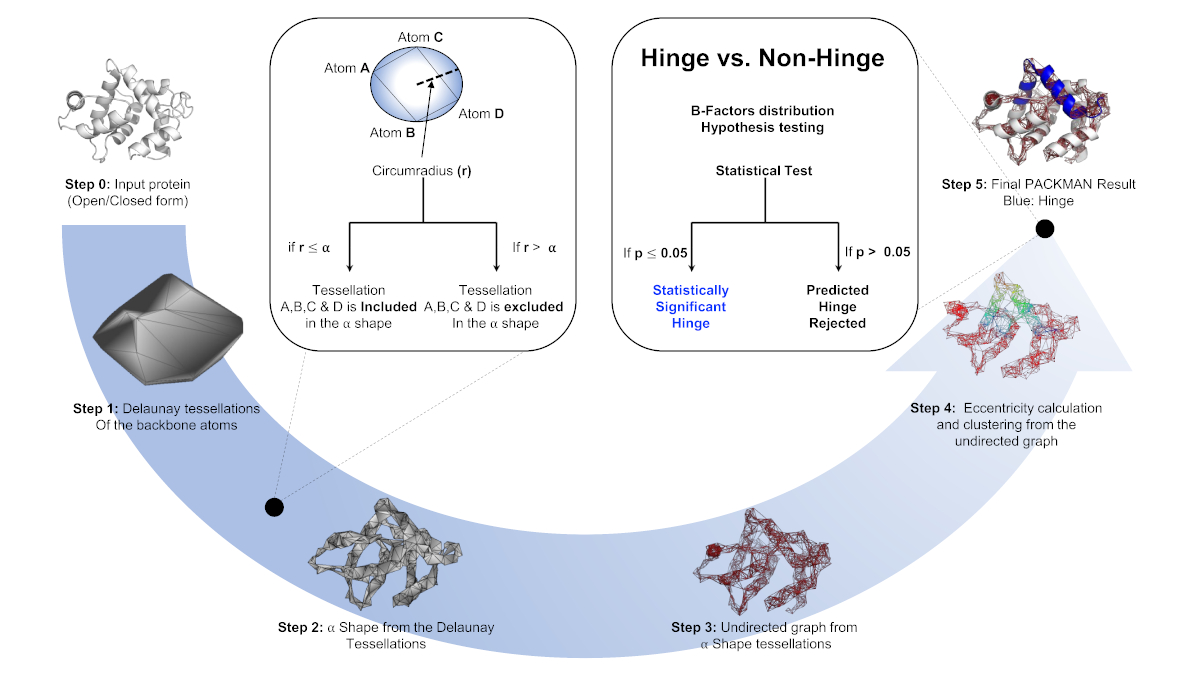
Step 1: Loading Structure
In this section, we load the file containing the molecular structure. To understand in dept about the packman.molecule object, pelase visit Using ‘Molecule’ to load and manupulate molecular structures. (Basics)
Code Example:
from packman import molecule

#File loading
mol=molecule.load_structure('1exr.cif')
#OR
#mol=molecule.load_structure('1exr.pdb')

#If the backbone atoms of the ALL chains needs to be studied,
#backbone=[]
#for i in [i.get_id() for i in mol[0].get_chains()]:
#        backbone.extend( [k for j in mol[0][i].get_backbone() for k in j if k is not None] )


#If the backbone atoms of the specific chain 'A' needs to be studied,
backbone = [j for i in mol[0]['A'].get_backbone() for j in i if j is not None]
Step 2: Hinge Prediction
Call the packman.apps.predict_hinge with the backbone atoms selected in the Step 1 with specific alpha value and an output file:
predict_hinge(backbone, Alpha=2.8, outputfile=open('output.txt', 'w'))
This process can be done for the multiple alpha values.:
alpha_start, alpha_stop, step_size = 0 , 10 , 0.5
for i in numpy.arange(alpha_start, alpha_stop, step_size):
        i = numpy.around(i, decimals=1)
        try:
            predict_hinge(atoms, Alpha=i, outputfile=open(str(i)+'.txt', 'w'))
        except:
            continue
The output will be saved in the .txt format with alpha value as a filename.
Step 3: Hinge Objects
After running hinge prediction, along with the text output, packman.molecule.annotations.Hinge object is saved with all corresponding information.
The following code can access all such hinges for all alpha values explored:
#If chain is known,
mol[0]['A'].get_hinges()

#If you are browsing atoms and not sure about the chain
backbone[0].get_parent().get_parent().get_hinges()